LED lighting for UK sports halls
This guide is for schools, councils, leisure centres and facilities managers who need to light an indoor sports hall. It sets out how BS EN 12193:2018 classes work, which lux and uniformity figures apply to typical hall sports, how to control glare and impact, and which Polaris fittings are actually published for indoor halls. For a survey, a lux plot and a proposal, request a free survey.
Outdoor pitches and courts are covered separately in our sports lighting hub, including 5-a-side football, football floodlighting, tennis court lighting and padel court lighting. This page is about indoor halls.
Lighting classes in BS EN 12193
The UK standard for sports lighting is BS EN 12193:2018. It uses three classes. The class depends on the level of play and how far spectators are from the action:
- Class III covers basic competition, general training, school and recreational sport.
- Class II covers medium-level competition and performance training.
- Class I covers high-level competition.
Those class descriptions are the same wording we already use on the sports lighting hub. A school or community hall is often Class III. A club or regional competition hall may need Class II. Do not assume a class: agree it with the operator, and use a lighting design for the sports actually marked on the floor.
Lux levels and uniformity for typical hall sports
The figures below are maintained horizontal illuminance (average lux that must still be achieved after dirt and ageing) and uniformity U0, which is the minimum divided by the average, on the principal playing area. They are taken from BS EN 12193:2018. We have not added prices, and we have not assumed a class for your hall.
| Indoor sport | Class III | Class II | Class I |
|---|---|---|---|
| Basketball, volleyball, handball, indoor football / futsal | 200 lux, U0 0.5 | 500 lux, U0 0.7 | 750 lux, U0 0.7 |
| Badminton and table tennis | 300 lux, U0 0.7 | 500 lux, U0 0.7 | 750 lux, U0 0.7 |
Source: BS EN 12193:2018 Sports lighting. Values are maintained horizontal illuminance and uniformity (Emin / Eaverage) on the principal playing area.
A multi-sport hall should not be judged on a single generic lux figure. The standard expects the installation to be checked for each sport marked on the floor, using that sport's grid. In practice, the design often has to meet the most demanding combination. At Class III, badminton at 300 lux with 0.7 uniformity is tighter than basketball at 200 lux with 0.5 uniformity, so a hall used for both should be designed with the badminton figures in mind.
Indoor padel and indoor tennis have their own published figures. Use the padel court lighting guide for LTA and SAPCA values, and the tennis court floodlighting guide for tennis. We do not mix those tables into the hall table above.
Uniformity matters as much as the average lux. Dark patches make it harder to judge a fast ball or shuttle. The 0.7 figure on badminton, even at Class III, is there for that reason.
Glare control
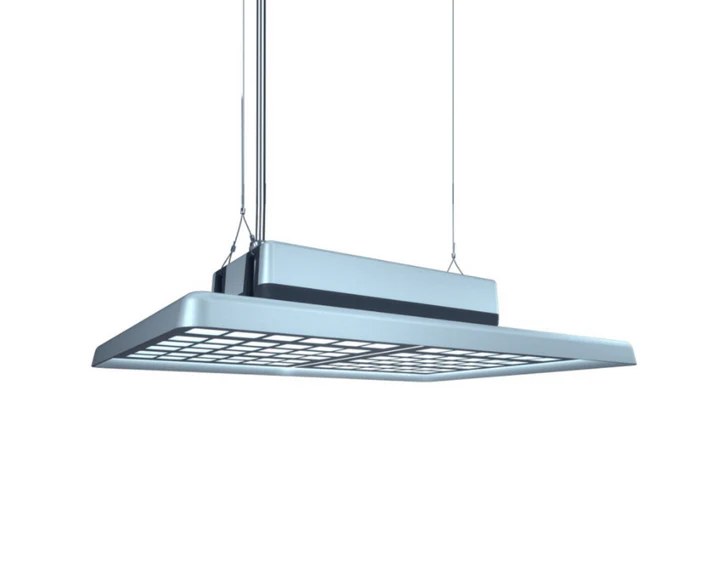
In a sports hall, people look up. A fitting that is comfortable in a warehouse aisle can still be harsh when a player is watching a shuttle or a high ball. PS-MILD is a low glare LED high bay published for warehouses, workshops, sports halls and gyms. It keeps UGR below 19, so the light is comfortable to work and play under.
UGR is a unified glare rating used for indoor workplaces and similar interiors. BS EN 12193 also sets glare limits for sports lighting, in the terms used by that standard. We do not treat a published UGR figure as a substitute for a sports-lighting glare calculation, and we do not invent a glare rating that is not on the product data. The safe approach is a low-glare fitting plus a lux plot that checks aiming, spacing and mounting height for the sport.
For volleyball in particular, fittings should not sit directly over the court if that would put a bright source in the player's upward view. The same caution is useful for badminton. The design, not a catalogue page, decides the layout.
Ball impact, IK ratings and guards
Hall fittings can be struck by a ball. Impact resistance is published as an IK rating under EN 62262. As we already note on the best LED high bay lights comparison, IK10 is 20 joules and IK08 is 5 joules.
- PS-MILD is published as IK10, as well as IP65.
- PS-UFO-MAX is published as IK08 and IP65.
IK10 is the highest rating on that scale and is the better starting point where a ball may hit a fitting. A separate ball-impact test used in some hall specifications, such as DIN 18032-3, is not stated on the cited PS-MILD or PS-UFO-MAX sources, so we do not claim that test here. If a project specification requires a tested wire guard, cage or a named ball-impact class, that requirement should be written into the design and checked before order. We do not list a standard wire guard as a published PS-MILD accessory on the current product data.
Which Polaris products suit an indoor hall?
Only fittings whose published applications or characteristics actually suit an indoor hall are recommended here. Outdoor sports floodlights are for pitches and courts, not a typical school or leisure hall.
| Product | Why it is relevant | Published data | Warranty |
|---|---|---|---|
| PS-MILD | The high bay published for sports halls and gyms, and for other spaces where people look up | UGR below 19; 60 to 300 W in six models, 7,800 to 43,200 lm; IP65 and IK10; 10 kV surge protection; -40 C to +50 C; CRI Ra greater than 80 | 5 years |
| PS-UFO-MAX | A switchable UFO high bay for tall, open interiors, with a plug-in sensor, when a low-glare optic is not the first requirement | 100, 150 or 200 W selected on site; 190 lm/W; 38,000 lm at 200 W, calculated from 190 lm/W; IP65 and IK08; beams 45, 60, 90 and 120 degrees; plug-in PIR or microwave and daylight sensor; -40 C to +60 C | 5 years |
Figures are those already published on the PS-MILD and PS-UFO-MAX product pages. PS-UFO-MAX lumens at 200 W are labelled as calculated. No UGR figure is stated on the cited PS-UFO-MAX sources, so that point is not scored or assumed here.
PS-CURVE is a linear high bay with aisle optics for racking. It is not the fitting to specify for a sports hall floor. PS-POWER, PS-FIELD and PS-MAST are sports floodlights for outdoor pitches and similar applications. If the building also contains a padel court, use PS-PADEL-LINEAR for that court, with a 7-year warranty; it is not a general hall high bay.
Lower corridors, changing rooms and plant rooms are a different task. A sensor batten such as PS-BATTEN may suit those ancillary spaces, but it is not a sports hall playing-area fitting. Workplace lux figures for back-of-house areas are in the UK lux levels guide.
Controls and dimming
School and leisure halls are often used for sport in the evening, for exams or assemblies in the day, and sometimes only in parts of the floor. A single full-power scene wastes energy and can be too bright for non-sport use.
PS-UFO-MAX includes a plug-in PIR or microwave and daylight sensor, with settings that can be adjusted with an optional handheld remote. Power can also be set on site to 100, 150 or 200 W. Dimming for PS-MILD is listed as available on request on our warehouse lighting comparison; it is not listed as a standard built-in sensor on the PS-MILD product page, so we do not describe it as included. If you want wireless occupancy or daylight control across a larger site, see Polaris Mesh.
The control choice should be part of the lighting design, not an afterthought. Sensors must be aimed so that play is not interrupted by a false "empty hall" dim, and exam or assembly scenes should be agreed with the operator.
Retrofit or new build
Most UK sports hall projects are retrofits: fluorescent or HID high bays on an existing grid, sometimes with poor uniformity and high glare. A new-build hall can set mounting height, cable routes and control scenes from the start. In both cases the lighting should be designed, not guessed from a wattage rule of thumb.
- Survey the hall: length, width, mounting height, existing points, the sports marked on the floor, and how the space is used through the week.
- Agree the BS EN 12193 class and produce a lux plot before anyone orders fittings.
- Reuse existing mounting points where the design allows. If the old grid cannot meet uniformity or glare, the design should say so rather than copy a poor layout.
- Plan controls for sport, teaching and cleaning scenes, and check emergency lighting as a separate task. See emergency lighting for the approach we use on industrial sites, and agree the hall's emergency requirements in the survey.
- Install and commission against the design.
How a project runs from survey to switch-on is set out in LED high bay installation and in the 5 critical steps to a successful LED lighting project. Polaris Light surveys the building, produces a lux plot, supplies the fittings and installs with our own team.
Every product on this page carries a 5-year warranty. PS-PADEL and PS-PADEL-LINEAR, if a padel court is part of the same building, carry a 7-year warranty. We have not quoted energy-saving percentages here, because they depend on the existing fittings, hours of use and the agreed lighting class. For a first illustration only, you can use the LED savings calculator; a proposal should still use the surveyed figures.
Frequently asked questions
How many lux does a sports hall need?
It depends on the sports marked on the floor and the lighting class in BS EN 12193:2018. Class III covers school, recreational and general training use; Class II covers medium-level competition; Class I covers high-level competition. For basketball, volleyball, handball and indoor football, Class III is 200 lux with 0.5 uniformity, Class II is 500 lux with 0.7 and Class I is 750 lux with 0.7. Badminton and table tennis use 300 lux with 0.7 uniformity at Class III. A multi-sport hall should meet every sport played in it. Ask for a lux plot.
Which LED lights suit a sports hall?
PS-MILD is the Polaris high bay published for sports halls and gyms. It keeps UGR below 19 and is rated IP65 and IK10, in six models from 60 to 300 W. PS-UFO-MAX can suit a tall, open hall where a switchable 100, 150 or 200 W UFO high bay and a plug-in sensor are useful, but it is IK08 and no UGR figure is stated on the cited sources. Aisle-optic linear high bays and outdoor sports floodlights are not the starting point for a typical indoor hall.
Why does glare matter in a sports hall?
Players often look up to follow a ball or shuttle. A very bright source in the line of sight is uncomfortable and can hide the ball. PS-MILD is published as UGR below 19 for that reason. The hall should still be designed so fittings are aimed and spaced to the sport, and a lux plot should be checked before installation.
Do sports hall lights need to be ball-impact resistant?
Fittings in a hall can be struck by a ball. IK ratings describe impact energy on the EN 62262 scale: IK10 is 20 joules and IK08 is 5 joules. PS-MILD is published as IK10. PS-UFO-MAX is published as IK08. A separate ball-impact test, such as DIN 18032-3, is not stated on the cited Polaris product sources, so we do not claim it here. If a specification asks for a tested guard or cage, that requirement should be checked in the design.
Can we retrofit LED into an existing sports hall?
Often yes, but the layout should still be designed, not copied blindly from the old grid. We survey the hall, record mounting heights and existing points, and produce a lux plot to the BS EN 12193 class you need. Existing mounting points can be reused where the design allows. For how a typical project runs, see LED high bay installation and the 5 critical steps to a successful LED lighting project.
Do you design and install sports hall lighting?
Yes. Polaris Light surveys the building, produces a lux plot, supplies the fittings and installs with our own team. PS-MILD and PS-UFO-MAX carry a 5-year warranty. Every Polaris product has a warranty of at least 5 years.