Best LED high bay lights in the UK, ranked by luminaire lm/W
This page compares popular commercial UFO high bays on published luminaire lumens per watt, at the closest available wattage to 150 W, plus IP, IK, beam, sensors and warranty. It is published by Polaris Light Ltd, which supplies and installs PS-UFO-MAX. It is not an independent review.
The finding. On published luminaire lm/W in this comparison, PS-UFO-MAX is first at 190 lm/W. Lumens at 100, 150 and 200 W are calculated from that figure and labelled as calculated.
The caveat. That is not an overall winner. Several competitors are published as IK10, where PS-UFO-MAX is IK08. Wattages are not identical across every row, so the wattage of each cited figure is stated.
This comparison is by Polaris Light, not an independent review.
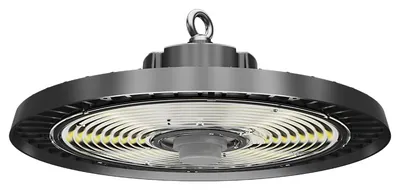
Every figure below is taken from a manufacturer datasheet or product page, or it is labelled as calculated. Manufacturer tolerances are typically ±10% on flux and power. Sources and access dates sit in the table and in the methodology. For how to choose a high bay, see the LED high bay lights guide and warehouse LED upgrade guide.
The table ranks on published luminaire lm/W. Wattages are not identical across every row, so the wattage of each cited figure is stated. Where a product publishes figures at 100, 150 and 200 W, we use the 150 W figure for ranking and still show the others. Philips CoreLine Highbay Gen5 is listed on its 121 W PSU code, because that is the datasheet code we have.
PS-UFO-MAX lumens are calculated from 190 lm/W: 19,000, 28,500 and 38,000 lm at 100, 150 and 200 W. Those lumen figures are labelled as calculated. A DIP switch sets 100, 150 or 200 W in one fitting, so the same product can use less energy when full output is not needed. At the lower settings the LEDs are not driven at full power, so they run cooler and last longer than at 200 W. We have not published a lifetime in hours for those lower settings. A plug-in PIR and daylight sensor is included with the fitting, at no extra charge.
Ranked by published luminaire lm/W
| Rank | Product | lm/W | Lumens and watts | IP | IK | Beam | Sensors and controls | Warranty | Source |
|---|---|---|---|---|---|---|---|---|---|
| 1 | Polaris PS-UFO-MAX | 190 Best | 19,000 / 28,500 / 38,000 lm at 100 / 150 / 200 W | IP65 | IK08 | 45° / 60° / 90° / 120° (90° standard) | Plug-in PIR and daylight sensor included. DIP switch 100 / 150 / 200 W. DALI available. | 5 years Best, tied | Product page and spec sheet, November 2026. Efficacy 190 lm/W as specified for this fitting. Lumens calculated: watts × 190. |
| 2 | Ansell Ocu-Lux High Bay | 185 | Not published | IP65 | IK10 Best, tied | 110° | OCTO-ready; Zhaga sensor socket | Not stated on the product page | Ansell product page, accessed 16 November 2026. Manufacturer declared efficacy. Also stated as ball-impact tested to DIN 18032-3. Flux is not published on the product page. The fitting is listed as 80 / 120 / 160 W, multi-wattage. |
| 3 | Ansell Z LED Performance Highbay | 180 | 18,000 / 27,000 / 36,000 lm at 100 / 150 / 200 W | IP65 | IK10 Best, tied | 120° (55° lens option) | 1-10 V standard; DD3 digital and OCTO options | Not stated in the cited catalogue | Ansell Solutions 18 catalogue, accessed 16 November 2026. Manufacturer declared. Catalogue year is not printed on the pages we used. |
| 4 | Integral Perform Pro Max Circular | 180 | 21,600 / 26,880 lm at 90 / 120 / 150 W | IP65 | IK08 | 90° | 0-10 V; Zhaga 18 sensor / Casambi | 5 years Best, tied | Integral product page (code ILHBC351), accessed 16 November 2026. Manufacturer declared. This range tops out at 150 W, so it is not a 200 W like-for-like. No 200 W code in the cited source. |
| 5 | Philips CoreLine Highbay Gen5 | 169 | 20,500 lm at 121 W (PSU) | IP65 | IK08 | 85 × 85° wide beam | On/off (PSU) or DALI-2 (PSD) | 5 years Best, tied | Signify datasheet for BY121P G5 LED200S/840 PSU WB, 4 December 2023, and the PSD WB datasheet, 12 December 2025. Manufacturer declared. A side-by-side page is at PS-UFO-MAX versus Philips CoreLine Highbay Gen5. The DALI-2 code is 163 lm/W at 126 W, same 20,500 lm. |
| 6 | Luceco Titan All-in-One | 167 | 17,500 / 25,000 / 31,000 lm at 100 / 150 / 200 W | IP65 | IK08 | 60° / 90° | 1-10 V; Zhaga sensor socket | 5 years Best, tied | Luceco manufacturer spec sheet, undated, accessed 16 November 2026. Manufacturer declared. Lumens quoted at 5000 K. Declared 170 / 167 / 155 lm/W. Photometric values on the same sheet are 175 / 166.65 / 154.98 lm/W at 90°. Ranked on 167 at 150 W. At 200 W the declared figure is 155. |
| 7 | Integral Performance Pro Circular | 165 | 16,500 / 24,750 / 33,000 lm at 100 / 150 / 200 W | IP65 | IK08 | 90° | Dimmable; sensor ready | 5 years Best, tied | Integral product page, accessed 16 November 2026. Manufacturer declared for the 4000 K, 90° codes. |
| 8 | Knightsbridge Potentia High Bay | 162 | 16,500 / 19,000 / 23,000 lm at 100 / 120 / 150 W | IP65 | IK08 | 90° | DALI / 0-10 V | 5 years Best, tied | Manufacturer datasheet for POTHB1, hosted by a distributor, September 2023 upload, POTHB1 datasheet. Manufacturer declared. Declared 169 / 165 / 162 lm/W at 4000 K. Ranked on 162 at 150 W. At 100 W the declared figure is 169. |
| 9 | Kosnic Cirrus 3 | 150 Calculated | 22,500 lm at 150 W (switchable 90 / 120 / 150 W) | IP65 | IK10 Best, tied | 90° | Not dimmable; emergency modules | Not stated on the cited sheet | Kosnic manufacturer spec sheet, undated, accessed 16 November 2026. Headline “up to 160 lm/W” is not used for ranking. 22,500 ÷ 150 = 150 lm/W, rounded. The ranked value is calculated from the published 150 W flux. |
| 10 | JCC Toughbay Pro | 140 | 12,800 / 17,100 / 21,000 lm at 80 / 115 / 150 W | IP65 | IK10 Best, tied | 60° / 90° / 120° | 1-10 V | 5 years, including 1 year on site Best, tied | Manufacturer datasheet for JC040206, hosted by a retailer, undated, accessed 16 November 2026, Toughbay Pro datasheet. Manufacturer declared (lumens per circuit watt). Declared 171 / 149 / 140 lm/W. Ranked on 140 at 150 W, not on the 171 lm/W 80 W figure. Range also includes 100 / 150 / 200 W codes. |
(blue tint, left rule) marks the best published value in that row. Ties are all marked. A cell that says not stated is not treated as best.
Best for, by criterion
These labels are for a single published criterion only. They are not an overall best, and they are not a best-value claim.
Best for efficacy
PS-UFO-MAX, at 190 lm/W, is the highest published luminaire lm/W in the ranked table. Lumens are calculated from that figure (19,000 / 28,500 / 38,000 lm at 100 / 150 / 200 W) and labelled as calculated. Source: product page and spec sheet, November 2026.
Best for impact (IK)
Ansell Ocu-Lux, Ansell Z LED Performance, Kosnic Cirrus 3 and JCC Toughbay Pro are published as IK10 in the cited sources. PS-UFO-MAX is IK08.
Best for beams
PS-UFO-MAX is published with 45°, 60°, 90° and 120° beams, with 90° as the standard. JCC Toughbay Pro is also published with 60° / 90° / 120°, and Luceco Titan with 60° / 90°.
Best for warranty
PS-UFO-MAX, Integral Perform Pro Max, Philips CoreLine Highbay Gen5, Luceco Titan, Integral Performance Pro, Knightsbridge Potentia and JCC Toughbay Pro are each stated with a 5-year warranty in the cited sources (JCC including 1 year on site). Warranty is not stated on the Ansell product page or catalogue we used, or on the Kosnic sheet.
Where competitors lead
Several fittings in this table are published as IK10: Ansell Ocu-Lux, Ansell Z LED Performance, Kosnic Cirrus 3 and JCC Toughbay Pro. PS-UFO-MAX is IK08. IK10 is a higher impact rating (20 joules against 5 joules on the EN 62262 scale). That can matter in sports halls and in some warehouses where fittings may be struck. On many high-mounted warehouse applications IK08 is sufficient, but we do not treat the products as equal on this point.
Integral Perform Pro Max and Knightsbridge Potentia do not have a 200 W code in the sources cited, and Philips CoreLine is documented here at 121 W (PSU) or 126 W (DALI). Those rows are still ranked on published lm/W, with the wattage shown, rather than forced into a 200 W column we do not have.
Side-by-side readings are also on PS-UFO-MAX versus Philips CoreLine Highbay Gen5 and PS-UFO-MAX versus Collingwood Springbok Lite. How sensors are supplied is grouped on LED high bay lights with sensors.
Want figures for your own site? We will survey, produce a lux plot and a light spill drawing where planning needs it, and send a proposal. Every Polaris product carries a 5-year warranty.
What we left out or flagged
A V-TAC UFO high bay appears widely at UK trade counters. The figure we found is 160 lm/W at 100 W and 16,000 lm, from a retailer listing only, accessed 16 November 2026. We did not obtain a manufacturer datasheet by the data date, so that product is not in the ranking. If a current V-TAC datasheet is sent through our contact form, we will review it.
We also checked, and have not ranked, Luceco Eco Eris (135 lm/W), Luceco Ceres (140 lm/W at 200 W, IK10), Philips Ledinaire High-bay G3 (150 lm/W), Enlite Ariah Pro (150 lm/W), Ansell Z LED ECO (120 lm/W) and 4lite 100 W (140 lm/W). Calex Performance (100 lm/W, retailer only, plastic body) is not like for like for industrial use. LEDVANCE High Bay Compact G2 and Lexco Leonis were found only as retailer listings with incomplete or unverified IK data, so they are omitted until a manufacturer datasheet is available. A 2017 Thorn HiPak brochure (up to 130 lm/W) was treated as legacy and excluded.
Other Polaris high bays are outside this UFO comparison: PS-CURVE is a linear aisle fitting, PS-FOOD is a wash-down product, PS-MILD is a low-glare range, and PS-ATEX-HIGHBAY is for hazardous areas (UKEX certified).
How to read lumens per watt
A 200 W high bay at 190 lm/W delivers 38,000 lumens, calculated. A 200 W high bay at 155 lm/W delivers 31,000 lumens on the Luceco Titan figures above. That is a published (or calculated) light output difference at the same system load, not a running-cost quote, and it says nothing about glare, uniformity or aisle lighting on a particular site. For the role of efficacy in a buying decision, see why every LED buying decision should include lumens per watt. Ask for a lux plot before you buy.
Methodology
- Criterion: luminaire lm/W (lumens out of the fitting ÷ system watts) at the closest published wattage to 150 W. The wattage of each figure is stated in the table.
- Tolerance: manufacturer ratings are typically subject to a ±10% tolerance on flux and on power.
- Calculated values: PS-UFO-MAX lumens are watts × 190, labelled as calculated. Kosnic Cirrus 3 is ranked on 22,500 lm ÷ 150 W = 150 lm/W, not on the headline “up to 160” figure.
- Like for like: commercial UFO high bays. Linear, low-glare, wash-down, domestic and hazardous-area fittings are out of scope or named as such. Budget retailer-only products that are not industrial like-for-like are excluded.
- Data date: 16 November 2026. Datasheet dates are given where the publisher printed one.
- Review: we intend to review these figures each quarter. The next review is February 2027.
- Corrections: if you publish a datasheet that updates a figure on this page, please use our contact form. We will check it and amend the table if the source supports the change.
- Authorship: this page is written and published by Polaris Light Ltd, a supplier of one of the products compared.
Frequently asked questions
What does luminaire lm/W mean?
It is the lumens leaving the fitting divided by the system watts of that fitting. It is not a chip-only or LED-only efficacy claim. Calculated values on this page are labelled.
Why are the wattages not all the same?
Not every manufacturer publishes a 150 W or 200 W code in the sources we have. The table ranks on published luminaire lm/W and states the wattage of each figure, rather than inventing a missing wattage.
Is this an independent test or review?
No. The page is published by Polaris Light Ltd, which supplies and installs PS-UFO-MAX. The ranking uses published manufacturer figures, with calculated values labelled. We have not laboratory-tested the competitor products for this page.
Where do competitors beat PS-UFO-MAX?
On impact rating: Ansell Ocu-Lux, Ansell Z LED Performance, Kosnic Cirrus 3 and JCC Toughbay Pro are published as IK10. PS-UFO-MAX is IK08. Some rivals also offer a Zhaga sensor socket or a documented DALI-2 code as standard.
Are sensors included with PS-UFO-MAX?
Yes. A plug-in PIR and daylight sensor is included with the fitting, at no extra charge. A microwave sensor option and a handheld remote are also available.
What warranty does PS-UFO-MAX have?
Every Polaris product, including PS-UFO-MAX, carries a 5-year warranty.
How can a figure on this page be corrected?
Send the current manufacturer datasheet through our contact form. We will compare it with the cited source and update the table if the published data has changed.