Best padel court lights: 9 fittings compared on published data
This page compares published luminaire data for padel court lights, grouped by type of fitting. It is written and published by Polaris Light Ltd, a supplier of PS-PADEL-LINEAR. It is not an independent review.
Two types of fitting, two tables, no overall rank. Pick the type for your court.
Indoor and covered courts. Table A
190lm/W
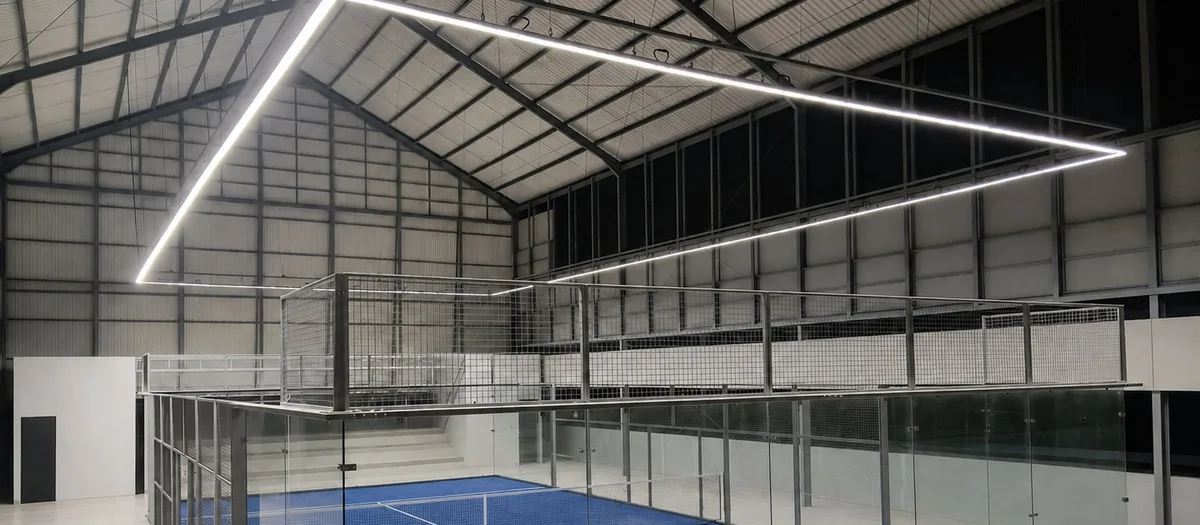
PS-PADEL-LINEAR, continuous linear run, published at 190 lm/W on the 80 W model, Ra >80. Onto OP Luma does not publish lm/W; the 85.7 and 80 lm/W figures in Table A are calculated from published lm and W, not Onto's claim.
- P30 cut-off optic
- IP65
- IK10
- DALI-2 and D4i
- 7-year warranty
Outdoor courts. Table B
190lm/Wat 250 W
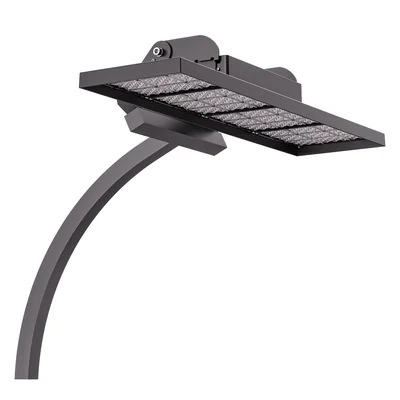
PS-PADEL, side-mounted padel floodlight in 150 W and 250 W, published at 190 lm/W at CRI >70. Highest published lm/W in Table B; next is Kellwood Dawson at 182 lm/W (150 W, CRI >70).
- 150 W and 250 W
- CRI >70
- IP66
- IK10
- 7-year warranty
Sources: PS-PADEL-LINEAR product page and spec sheet v4, November 2026. PS-PADEL product page and spec sheet v1, November 2026. Competitor figures as listed under Table B, checked 18 November 2026. Table A and Table B are not compared with each other. Published by Polaris Light Ltd, not an independent review.
In short: For indoor and covered courts, PS-PADEL-LINEAR is a continuous linear run published at up to 190 lm/W (Ra greater than 80), with a P30 cut-off optic and a 7-year warranty. For outdoor side-mounted floods, PS-PADEL is published at 190 lm/W at CRI greater than 70, with a 100 x 60 degree asymmetric optic, IP66, IK10 and a 7-year warranty. Outdoor side-mounted floods are a different type of fitting, so they are compared in a separate table, not ranked against the linear runs.
If a 10-year warranty matters most, look at Low Energy Designs LumiPADEL or the Padel Plus UK system. Led Projects is the official FIP lighting supplier, but it does not publish luminaire lm/W, so it is not compared on that measure. Efficacy is only one column, next to glare control, IP, IK, warranty, controls and mounting. Figures were taken from published datasheets and product pages, checked on 18 November 2026.
Get a free survey and lux plot PS-PADEL-LINEAR spec sheet
Free lighting survey for your courts
Tell us about the courts and we will send a lux plot and a proposal. Or use the contact form.
Sorry, the form did not send. Please try again or email hello@polarislight.com.
Which type do you need?
Padel lighting is not one product type. Indoor and covered courts often use a continuous linear run, sometimes called halo or perimeter lighting, around or above the court. Outdoor courts more often use four or eight side-mounted floodlights. Hall panels are a third type, used in some indoor centres. The tables below keep those types apart, because ranking them together would compare unlike products.
Indoor and covered linear runs
A slim continuous line of fittings on the guardrail or hung from the roof. This is what PS-PADEL-LINEAR is for. See Table A.
Outdoor side-mounted floods
Floodlights on the sides of the court, usually four or eight fittings, often with a 100 x 60 degree padel optic. These are compared in Table B. Polaris also makes PS-POWER with a 100 x 60 degree padel optic; it is linked after that table, not ranked in it.
Glass-walled courts need a cut-off or low-glare optic. Players watch the ball come off the glass and often look up into the lights, so a design that only reports horizontal lux on the floor can miss glare on the walls. For lux levels, planning and layouts, use the padel court lighting guide. For a survey and installation, see padel court lighting.
Indoor and covered linear runs, compared on published data
Rows are ordered by published luminaire lm/W, where that figure is published. There is no overall rank and no number one badge. The best published value in each column is in bold, whoever holds it. Court lux depends on mounting height, layout, maintenance factor and the standard you design to, and is not a column we can fill from luminaire catalogues alone.
| Product | Type | Published lm/W | Flux and wattage | Optic and glare | IP | IK | Mounting | Controls | Warranty | Source |
|---|---|---|---|---|---|---|---|---|---|---|
| PS-PADEL-LINEAR (Polaris) | Continuous linear run | Up to 190 lm/W, Ra >80 | 4,560 / 7,600 / 9,900 / 10,800 / 15,200 lm at 24 / 40 / 55 / 60 / 80 W | P30 asymmetric cut-off | IP65 | IK10 | Guardrail bracket or suspension | DALI-2, D4i, 0/1-10V, PWM, knob dimmer | 7 years | [1] |
| Onto OP Luma | Suspended modular indoor run | 85.7 / 80 lm/W, calculated from published lm and W | 3,600 / 6,720 lm at 42 / 84 W | Not published | Listed as indoor; IP not published | Not published | 1,160 x 110 mm modules; court layout stated as 60 modules | Not published | Not published | [2] |
- PS-PADEL-LINEAR (Polaris). Product page and spec sheet v4, November 2026
- Onto OP Luma. ontopadel.com/lighting, 18 November 2026. Onto does not publish a luminaire lm/W figure. The 85.7 lm/W (42 W) and 80 lm/W (84 W) figures are calculated from the published 3,600 lm at 42 W and 6,720 lm at 84 W. They are not Onto's published claim.
Kellwood Dawson can be used indoors, but it is a four-fitting flood format, so it appears in Table B, not here. Led Projects LINE+ is a linkable linear system, but luminaire lm/W is not published, so it is in the block below the tables.

Get this for your court, free
We will produce a lux plot for your courts and send a proposal. There is no obligation.
Sorry, the form did not send. Please try again or email hello@polarislight.com.
Outdoor side-mounted floods, compared on published data
Rows are ordered by published luminaire lm/W. There is no overall rank. The best published value in each column is in bold. These fittings are not compared with the linear runs in Table A.
| Product | Type | Published lm/W | Flux and wattage | Optic and glare | IP | IK | Mounting | Controls | Warranty | Source |
|---|---|---|---|---|---|---|---|---|---|---|
| PS-PADEL (Polaris) |
Padel-specific flood, indoor or outdoor | 190 lm/W at CRI >70 | 28,500 lm at 150 W; 47,500 lm at 250 W | 100 x 60 degree asymmetric, ULR 0%, no back light | IP66 | IK10 | Typically four fittings per court, 0 degree horizontal at 6 m | 1-10V, PWM, Triac (optional); DALI-2 (optional) | 7 years on the fitting | [1] |
| Kellwood Dawson Series | Padel-specific flood, indoor or outdoor | 182 lm/W at CRI >70, 5000K (150 W); 180 lm/W (250 W) | 27,300 lm at 150 W; 45,000 lm at 250 W | 100 x 60 degree asymmetric, ULR 0% | IP66 | IK10 | Typically four fittings per court (manufacturer claim) | 1-10V / DALI / DALI-2 | 5 years, UK projects only | [2] |
| Low Energy Designs LumiPADEL | Padel flood | 178 lm/W (page-level claim) | 240 W or 320 W; flux not published | Not published | Not published | Not published | Not published | Bluetooth, PIR and microwave described at system level | 10 years (page-level claim for all products) | [3] |
| Dimay 150 W padel floodlight | Retail padel flood | 170 lm/W, 5000K, CRI >70 | 25,500 lm at 150 W | 100 x 60 degree asymmetric | IP66 | IK08 | 332 x 57 x 264 mm | Not dimmable | 5 years | [4] |
| Schréder INDU FLOOD GEN2 | Multi-purpose industrial and sports flood, not a padel-only design | Up to 162 lm/W | 31 to 375 W packages; up to 60,900 lm at 375 W (Neutral White 740 maxima) | ULOR 0% | IP66 | IK09 | Bracket or post-top | 1-10V or DALI 2.0; optional motion sensor | Not published in the March 2020 product sheet | [5] |
| AFP Padel Linear Light (SCC Courts) | Padel flood / linear flood | Up to 160 lm/W, 5000K, Ra 70 | Up to 38,400 / 51,200 / 80,000 lm (models FR-SP-AFP240 / 320 / 500) | 110 x 60 degree asymmetric | IP66 | IK10 | 888 / 1,325 / 2,191 x 372 x 70 mm | Not stated as a luminaire control set on the page fetched | 5 years | [6] |
| WELUMA 2KPandora (FLUXO mast system) | Outdoor flood | 160 lm/W, CRI >80 | 75 to 1,600 W; 12,800 to 259,400 lm | Asymmetric PC lenses, ULR 0.00% | IP65 | Not published | Mast system | 1-10V / DALI | 5 years | [7] |
- PS-PADEL (Polaris). Product page and spec sheet v1, November 2026. Efficacy is published at CRI >70.
- Kellwood Dawson Series. Product page and datasheet, 18 November 2026
- Low Energy Designs LumiPADEL. lowenergydesigns.com/padel-court-lighting, 18 November 2026. No separate datasheet was found on this pass.
- Dimay 150 W padel floodlight. Dimay product page, 18 November 2026
- Schréder INDU FLOOD GEN2. Application page and product sheet, March 2020. Example packages, Neutral White 740 maxima: 31 W up to 5,000 lm; 125 W up to 20,300 lm; 190 W up to 30,400 lm; 250 W up to 40,600 lm; 320 W up to 50,700 lm; 375 W up to 60,900 lm.
- AFP Padel Linear Light (SCC Courts). scc-courts.de/erweiterungen, 18 November 2026. Layout lux figures on that page are the supplier's calculations, not our measurements.
- WELUMA 2KPandora (FLUXO mast system). weluma-led.de/portfolio/2kpandora-led-flutlichtstrahler, 18 November 2026
A CRI basis note: PS-PADEL and Kellwood Dawson efficacy are published at CRI greater than 70. PS-PADEL-LINEAR is published at Ra greater than 80. Those are not the same test basis.
PS-PADEL is in Table B. For another outdoor side-mounted padel optic from Polaris, see PS-POWER (150 / 240 W padel versions, 170 lm/W, 100 x 60 degree padel optic at 5000K, IP66, 5-year warranty). PS-POWER is linked here rather than ranked in Table B.
Not compared on lm/W
Some products that appear in padel lighting search results do not publish luminaire lm/W, or they are a different type of fitting. They are listed here so a missing cell is not read as a lower position.
- Led Projects ICE and LINE+ (Spain). Official FIP lighting supplier. Catalogue 2026 publishes wattage, IP67, IK10, 5000K and a 5-year warranty on ICE and LINE+ (Show series: 3 years), plus layout illuminance for their standard court designs. Luminaire lm/W and lumens are not published, so there is no lm/W cell to rank. Sources: ledprojects.es and the 2026 catalogue. Their layout lux figures are for their own standard designs, not independent measurements.
- WELUMA 2K19 LED SPORT Panel (Germany). A hall sports panel, tennis-first and also offered for padel, not a 1,989 mm linear run. Published at 75 W, 11,000 lm plus or minus 5%, 150 lm/W, CRI greater than 80, UGR less than 22, and a 6-year warranty. Sources: WELUMA tennis hall page and the padel application page.
- Padel Plus UK linear system. A court-builder package with a 10-year warranty covering 100,000 hours, claimed adjustable 200 to 1,000 lux, and touch-screen control. No luminaire W, lm or lm/W was published on the page fetched. Source: padelplus.uk/products/lighting.
- Nexis Lighting Padel Plus is a different product from the Padel Plus UK system, despite the similar name. It is published at 240 / 320 W, 40,800 / 54,400 lm, IP66 / IK10, 5000K, CRI greater than 80, and a 7-year warranty. Source: nexislighting.co.uk/products/padel-plus. It was not one of the nine fittings in the tables above.
- Padellux UK describes an LED Padel system and generic floodlights and high bays, but the options page fetched had no wattage, lm/W, IP or IK. Source: padellux.co.uk/padel-lighting-options.
Where Polaris padel fittings lead, and where others lead
These two lists have the same weight. Each line is a sourced fact.
Where Polaris padel fittings lead
- Published luminaire lm/W among the indoor linear runs in Table A, at Ra greater than 80: up to 190 lm/W on the 24 W, 40 W and 80 W models of PS-PADEL-LINEAR.
- Published luminaire lm/W among the outdoor side-mounted floods in Table B, at CRI greater than 70: 190 lm/W on PS-PADEL, ahead of Kellwood Dawson at 182 lm/W on the same CRI basis.
- Published controls on that linear run: DALI-2, D4i, 0/1-10V, PWM and a knob dimmer.
- A slim 1,989 x 49 x 35 mm housing with IK10, for guardrail or suspended mounting on indoor and covered courts.
Where others lead
- Warranty: Low Energy Designs claims 10 years for all products, and Padel Plus UK claims 10 years on the whole system. Those claims beat the 7-year warranty on PS-PADEL-LINEAR and PS-PADEL. Nexis Lighting Padel Plus is also published at 7 years, a tie. WELUMA 2K19 hall panels are published at 6 years.
- Ingress: Led Projects is published at IP67, ahead of PS-PADEL-LINEAR at IP65 (specified for indoor and covered courts) and ahead of the IP66 floods in Table B, including PS-PADEL.
- Official competition association: Led Projects is the official FIP lighting supplier, with published layout classes in its 2026 catalogue.
- Published UGR: WELUMA 2K19 states UGR less than 22. Most rivals, including PS-PADEL-LINEAR, do not publish a UGR number. We have not invented one.
A continuous line over the glass
PS-PADEL-LINEAR hung in a rectangle over an indoor court, with a P30 asymmetric cut-off optic.
- 190 lm/W on the 80 W model
- IP65 and IK10
- DALI-2, D4i, 0/1-10V
- 7-year warranty
Polaris installation.
Standards by country
The numbers are not the same in every source, and they should not be mixed into one invented table of our own. Each figure below is in its own cell with its source. For the full UK tables, layouts and planning notes, read the padel court lighting guide (the guide PDF is on that page).
| Source | Where it applies | Published figure | Document |
|---|---|---|---|
| LTA Padel Court Data Sheet and SAPCA Code of Practice (September 2025) | UK, outdoor and indoor | 500 lux average, 0.7 uniformity, for national and international competition; 300 lux, 0.5 uniformity, for regional, school and recreational use; same figures indoors and outdoors; 0.9 maintenance factor; at least 6 m clear height, 8 m recommended for new build where feasible | LTA Padel Court Data Sheet and SAPCA Code of Practice, September 2025 |
| EN 12193 | Cited by German and Spanish suppliers for class tables | Outdoor and indoor classes are often listed with different lux. We do not invent a Polaris EN 12193 table here. Quote only the named source you are designing to. | Named as the standard only. Supplier class tables, where used, belong to those suppliers. |
| FIP | International play | At least 6 m to the underside of the fittings, as already cited on our guide from the FIP Rules of Padel; 8 m is recommended for new facilities in some of the texts we already cite | As cited on the padel court lighting guide. Broadcast figures in secondary guides or supplier catalogues are those sources' figures, not a FIP document we quote here. |
| Germany, LAI neighbour light | German planning context, not a UK rule | German guides discuss LAI neighbour illuminance, for example 3 lx / 1 lx in residential areas, 6 to 22 and 22 to 6. No padel-specific DIN was found as a published standard on this pass. | Cited as context only. These are not UK planning limits. |
PS-PADEL-LINEAR in detail
PS-PADEL-LINEARPS-PADEL is a slim 1,989 mm linear LED for indoor and covered padel courts. Models are 24, 40, 55, 60 or 80 W, giving 4,560, 7,600, 9,900, 10,800 or 15,200 lm, with efficacy up to 190 lm/W (190 lm/W on 24 W, 40 W and 80 W; 180 lm/W on 55 W and 60 W). It has a P30 asymmetric cut-off optic, an Inventronic remote driver, DALI-2, D4i, 0/1-10V, PWM and a knob dimmer, IP65, IK10, 180 to 528 V input and 10 kV surge protection. The warranty is 7 years. The full specification is in the spec sheet (PDF).
The lighting calculation next to the mid-page form is for a 20 x 10 m indoor doubles court with 30 PS-PADEL-LINEAR 80W fittings at 6 m, on a continuous perimeter line. We will produce a plot like this for your courts, free of charge.
Related fittings: PS-POWER for outdoor side-mounted padel lighting, and PS-TENNIS for fence-mounted tennis lighting, which is not a padel rank in the tables above. For installation, see padel court lighting and sports lighting.
Want a lux plot for your own courts?
Send the court plan and we will model the courts, send a lux plot and a proposal. PS-PADEL-LINEAR and PS-PADEL carry a 7-year warranty; every other Polaris product a 5-year warranty.
- Court plan and site survey
- Lux plot for your courts
- Written proposal and installation
Methodology
- How the page is organised: by type of fitting, then by published luminaire lm/W within each table. There is no overall rank across types, and lm/W is not a single score.
- Authorship: written and published by Polaris Light Ltd, a supplier of PS-PADEL-LINEAR. This is not an independent review.
- Tolerance: manufacturer ratings are typically subject to a ±10% tolerance on flux and on power unless the source states otherwise (Schréder states plus or minus 7% on flux and plus or minus 5% on power).
- Data date: 18 November 2026. Datasheet dates are given in the source column where they are stated.
- Review: we intend to review this page in the same quarterly cycle as our other comparison pages, next in February 2027.
- Corrections: if a manufacturer publishes a newer figure, use the contact form and we will check it.
- Tennis and sports floods: high-output sports floodlights are compared on best LED sports floodlights UK, not in these tables.
Frequently asked questions
How many lux does a padel court need?
In the UK, the LTA Padel Court Data Sheet and the SAPCA Code of Practice (September 2025) both set 500 lux average illuminance with 0.7 uniformity for national and international competition, and 300 lux with 0.5 uniformity for regional, school and recreational use. The figures apply to outdoor and indoor courts, with a 0.9 maintenance factor. Other countries may design to EN 12193 class tables, which can list different indoor and outdoor figures. See the standards table above and the guide for detail.
Do indoor and outdoor courts use the same lux levels?
In the LTA and SAPCA tables, yes: the 300 lux and 500 lux figures are the same indoors and outdoors. EN 12193 class tables used by some European suppliers often list different indoor and outdoor lux. Use the standard you are designing to, and do not mix the figures.
What is the difference between a linear run and padel floodlights?
A linear run, sometimes called halo or perimeter lighting, is a continuous line of slim fittings around or above the court. That is what PS-PADEL-LINEAR is for, on indoor and covered courts. Padel floodlights are side-mounted fittings, usually four or eight per court, more often used outdoors. They are compared in separate tables on this page because they are not like for like.
How high should padel lights be mounted?
The LTA, SAPCA and the FIP Rules of Padel, as already cited on our guide, require at least 6 m of clear height above the playing area, measured to the underside of the fittings. For new facilities, 8 m is recommended where it is feasible.
Do outdoor padel lights need planning permission in the UK?
Yes. The LTA says building a padel court is development and needs formal planning consent, including for fencing and for floodlighting posts and fittings. SAPCA says a lighting design pack is part of the application. See the guide for the planning notes.
Why does a glass court need a cut-off or low-glare optic?
Play uses the glass and mesh walls, so players watch a ball come off the surface and often look up into the lights. A design that only reports horizontal lux on the floor can miss glare and uneven light on the walls.
Can we convert existing padel floodlights to LED?
Often yes, but the new scheme still needs to be designed to the current standard, with the right maintenance factor. Check any existing planning consent and the posts or columns. On a glass court, a cut-off LED optic helps control glare on the walls. The guide covers this in more detail.
Which Polaris fitting is for indoor courts, and which is for outdoor courts?
PS-PADEL-LINEAR is the slim linear LED for indoor and covered courts, with a 7-year warranty. PS-PADEL is the padel floodlight for outdoor and indoor courts, at 150 or 250 W, 190 lm/W at CRI greater than 70, with a 7-year warranty. This page compares published linear and flood data. PS-PADEL is in Table B. PS-POWER is linked after Table B rather than ranked in it.
Want figures for your own court?
Request a free survey and lux plot. You can also download the PS-PADEL-LINEARPS-PADEL spec sheet, or start with the padel court lighting guide.
Sorry, the form did not send. Please try again or email hello@polarislight.com.