LED sports floodlights compared by published luminaire lm/W
This page compares high-output LED sports floodlights on published luminaire lumens per watt, and then discusses controls, beams and glare. It is published by Polaris Light Ltd, which supplies and installs PS-FIELD and PS-MAST.
The finding. On declared luminaire lm/W in this comparison, PS-FIELD is first at 180 lm/W, then PS-MAST at 170 lm/W.
The caveat. That is not an overall winner. Brochure figures published as “up to” a value, including Thorn Altis Gen5 and Abacus Challenger 3, are listed separately and are not ranked against declared per-wattage figures. Controls, beams, glare and spill often decide a scheme.
This comparison is by Polaris Light, not an independent review.
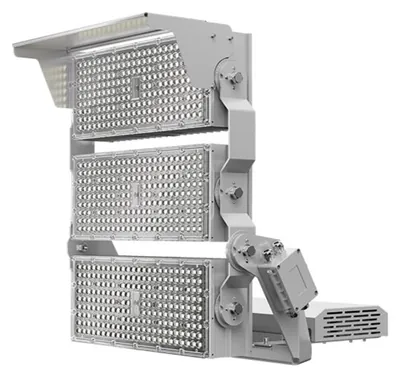
Sports buyers need more than a single efficacy number. Uniformity on the pitch, glare for players and neighbours, spill for planning, and the ability to dim or switch scenes for training, matches and events often decide the scheme. This page therefore ranks the fittings on published luminaire lm/W, then sets out controls and beam data from the same sources. For UK football lux levels, planning and testing, use the football floodlighting guide and the football pitch floodlights page.
A lower-wattage sports flood, PS-POWER (170 lm/W, 150 to 400 W), is not ranked here because it is not in the same output class as the 500 W to 1,800 W fittings in the table.
Ranked by declared luminaire lm/W
Where a manufacturer declares an efficacy for a stated wattage or product code, we use that figure and rank on it. Where the source says “up to” a value, or gives flux bands without a per-wattage table, we keep that wording and list the fitting separately, rather than ranking it against declared figures. We have not invented wattages to fill a gap.
| Rank | Product | Published lm/W | Published flux and wattage | IP | IK | Controls | Beams | Warranty | Source |
|---|---|---|---|---|---|---|---|---|---|
| 1 | Polaris PS-FIELD | 180 Best | 90,000 / 180,000 / 270,000 lm at 500 / 1,000 / 1,500 W | IP66 | IK08 Best, tied | DMX, DALI, ZigBee, 0/1-10 V | 20° / 30° / 60° | 5 years | Product page and spec sheet, November 2026. Manufacturer declared. |
| 2 | Polaris PS-MAST | 170 | 85,000 / 127,500 / 170,000 / 255,000 lm at 500 / 750 / 1,000 / 1,500 W | IP66 | IK08 Best, tied | DALI-2, D4i, DMX, 0/1-10 V | 20 / 30 / 45 / 90°, 100 × 60°, asymmetric | 5 years | Product page and spec sheet, November 2026. Manufacturer declared. Remote driver box. |
| 3 | Philips OptiVision LED gen3.5 (BVP528 2300/757 HGB A55-NB D9 OUT T45) | 152 | 197,000 lm initial system flux at 1,300 W initial input power | IP66 | IK08 Best, tied | DALI | A55 narrow beam asymmetric (50° to 16° × 116° stated as luminaire light beam spread) | 5 years | Signify datasheet, May 2024, filed in a UK planning application. Manufacturer declared for this code. Older gen3 variants were not used. |
| 4 | Abacus Challenger 1 LED | > 135 | 63,665 / 136,000 / 204,000 lm, 400 to 1,500 W | IP66 | Not stated on the datasheet | 3-channel DALI-2 / DMX | Multiple | 5 years | Abacus Challenger 1 datasheet, April 2026 upload. Manufacturer declared as greater than 135 lm/W. |
(blue tint, left rule) marks the best published value in that row. Ties are all marked. A cell that says not stated is not treated as best.
A side-by-side reading of PS-FIELD and Thorn Altis Gen5 is on PS-FIELD versus Thorn Altis Gen5. PS-FIELD and Philips OptiVision LED gen3.5 are compared at 1,500 W on PS-FIELD versus Philips OptiVision.
Best for, by criterion
These labels are for a single published criterion only. They are not an overall best, and they are not a best-value claim.
Best for efficacy
PS-FIELD, at 180 lm/W, is the highest declared luminaire lm/W in the ranked table. Source: product page and spec sheet, November 2026. PS-MAST is next, at 170 lm/W.
Best for impact (IK)
Abacus Challenger 3 is published as IK10 in its 1 June 2026 datasheet. That fitting is not ranked like for like, because its efficacy is an “up to” figure. Ranked fittings that state an IK rating (PS-FIELD, PS-MAST and the cited Philips OptiVision code) are IK08.
Best for beams
The Thorn Altis Gen5 June 2025 brochure describes the widest set in the sources cited, including an 11° narrow beam, extra-wide and asymmetric options, and tiltable modules. Altis is not ranked like for like. PS-FIELD is listed with 20°, 30° and 60° beams; PS-MAST with a wider published set, including 20 / 30 / 45 / 90° and asymmetric options.
Best for warranty
PS-FIELD, PS-MAST, the cited Philips OptiVision code and Abacus Challenger 1 are each stated with a 5-year warranty in the sources used for the ranked table. The Altis brochure states a five-year warranty for the Thorn European range.
Published as “up to”, not ranked like for like
These manufacturer sources publish an “up to” efficacy, or a flux band without a per-wattage table. They are named and sourced, but they are not ranked against declared per-wattage figures.
| Rank | Product | Published lm/W | Published flux and wattage | IP | IK | Controls | Beams | Warranty | Source |
|---|---|---|---|---|---|---|---|---|---|
| n/a | Thorn Altis Gen5 | Up to 164 | Up to 88,000 / 177,000 / 264,000 lm in 1 / 2 / 3-module versions. Wattages are not stated in the brochure used. | IP66 | IK08 | Fixed output, DALI-2, DMX-RDM | From 11° narrow beam to extra-wide and asymmetric options; tiltable modules | 5 years | Thorn Altis Gen5 brochure, June 2025. Manufacturer declared as “up to” 164 lm/W. The brochure states a five-year warranty for the Thorn European range. |
| n/a | Abacus Challenger 3 LED (AL7101 to AL7106) | Up to 162 | Up to 162,000 / 184,000 / 244,000 / 276,000 lm at 1,000 / 1,200 / 1,500 / 1,800 W (published as up to 162 / 153 / 162 / 153 lm/W by wattage) | IP66 | IK10 | DALI / DMX | Multiple | Not stated on the datasheet | Abacus Challenger 3 datasheet, revision 1, 1 June 2026. Manufacturer declared as “up to” the figures above. |
Where other products lead
- Abacus Challenger 3 is IK10. PS-FIELD and PS-MAST are IK08. That is a genuine difference on impact rating.
- Thorn Altis Gen5 publishes a wider set of beam options, including an 11° narrow beam, tiltable modules, and colour-changing configurations in the brochure. PS-FIELD is listed with 20°, 30° and 60° beams.
- The fittings in the table are published as IP66, except where a source is silent on that field.
- Sports lighting is also judged on TV and broadcast performance, glare, spill and governing-body lux and uniformity. A higher lm/W figure does not, on its own, mean a scheme will pass those tests. That needs a design and, where required, a light spill drawing.
Want figures for your own site? We will survey, produce a lux plot and a light spill drawing where planning needs it, and send a proposal. Every Polaris product carries a 5-year warranty.
Controls, beams and glare
All of the fittings in the table offer some form of lighting control. PS-FIELD lists DMX, DALI, ZigBee and 0/1-10 V. PS-MAST lists DALI-2, D4i, DMX and 0/1-10 V. Thorn Altis Gen5 lists fixed output, DALI-2 and DMX-RDM, and the brochure discusses flicker-free operation for HDTV broadcasting. Abacus Challenger 3 lists DALI and DMX; Challenger 1 lists 3-channel DALI-2 and DMX. The OptiVision gen3.5 code above is DALI.
Beam choice and aiming matter as much as efficacy for glare and spill. Altis highlights mixed optics and tiltable modules. PS-MAST lists a wider beam set than PS-FIELD, including asymmetric options and a remote driver box. We have not published a laboratory glare rating comparison for this page, so we do not rank the products on glare. For a specific pitch, the fair test is a lux plot and a spill drawing, not a catalogue headline.
Methodology
- Criterion for the table: published luminaire lm/W. Controls, beams, IP, IK and warranty are shown alongside, not rolled into a single score.
- Tolerance: manufacturer ratings are typically subject to a ±10% tolerance on flux and on power.
- Like for like: high-output sports and stadium floodlights. PS-POWER (150 to 400 W) is mentioned but not ranked against 500 W and above fittings. Tennis and padel fittings are covered on their own tennis and padel pages, not in this table.
- Data date: 16 November 2026. Brochure and datasheet dates are given in the source column.
- Review: we intend to review these figures each quarter. The next review is February 2027.
- Corrections: if you publish a datasheet that updates a figure on this page, please use our contact form.
- Authorship: this page is written and published by Polaris Light Ltd, a supplier of three of the products compared.
Frequently asked questions
Which sports floodlight in this table has the highest published lm/W?
PS-FIELD, at 180 lm/W, is the highest published figure in this table. Thorn Altis Gen5 is published as up to 164 lm/W, without a per-wattage table in the brochure we used.
Why is there no wattage for Thorn Altis Gen5?
The June 2025 brochure gives flux bands and an “up to 164 lm/W” efficacy, by module count, but not a watts table. We have not invented wattages to fill that gap.
Does a higher impact rating matter?
It can, on sites where fittings may take a ball strike or other impact. Abacus Challenger 3 is IK10. PS-FIELD and PS-MAST are IK08. The table shows that rather than treating the products as equal on every point.
Do you rank these floodlights on glare?
No. We have not published a like-for-like glare measurement for this page. Beam options and aiming are described from the cited sources. For a named pitch, we produce a lux plot and, for planning, a light spill drawing.
Is this an independent comparison?
No. It is published by Polaris Light Ltd, which supplies PS-FIELD and PS-MAST. Competitor figures are taken from the cited manufacturer sources.
What warranty do the Polaris fittings have?
Every Polaris product carries a 5-year warranty.
How can a figure on this page be corrected?
Send the current manufacturer datasheet through our contact form. We will compare it with the cited source and update the table if the published data has changed.